7 Reasons ZeroClaw Is the Ultra-Lightweight AI Agent Runtime Redefining Edge Computing in 2026
ZeroClaw is a Rust-based AI agent runtime that runs autonomous agents on $10 hardware with under 5MB of RAM. Launched on February 13, 2026, it reached 28,000+ GitHub stars in roughly seven weeks--making it the fastest-growing lightweight alternative to OpenClaw in the AI agent ecosystem.
Where OpenClaw demands 1GB+ of RAM and 5+ seconds for a cold start, ZeroClaw delivers a 99% memory reduction and 100x faster startup in a single 3.4MB binary. That's not incremental optimization. It's a structural shift that opens AI agent deployment to edge devices, IoT sensors, and $4/month VPS instances that were previously off-limits.
This analysis breaks down ZeroClaw's technical architecture, real-world performance, competitive positioning, and the risks you need to evaluate before adopting it.
Why ZeroClaw Matters: The Edge AI Gap OpenClaw Can't Fill
The AI agent market has been cloud-centric by default. OpenClaw, with 200,000+ GitHub stars and thousands of plugins, set the standard--but its Node.js foundation loads 800+ npm packages, consumes 1GB+ RAM, and takes 5+ seconds to cold start. That's fine for cloud servers. It's impossible for a Raspberry Pi Zero, an industrial sensor, or a drone controller.
ZeroClaw was built specifically to solve this constraint. Developed by Argenis De La Rosa and contributors from the Harvard, MIT, and Sundai.Club communities, it ships as a single statically-linked Rust binary that runs on 40+ target architectures. The project uses an MIT/Apache-2.0 dual license and hit 3,400 stars within 48 hours of its GitHub launch (ZeroClaw GitHub).
The growth trajectory signals something bigger than a niche tool: developers have been waiting for an AI agent runtime that doesn't require a cloud instance to function.
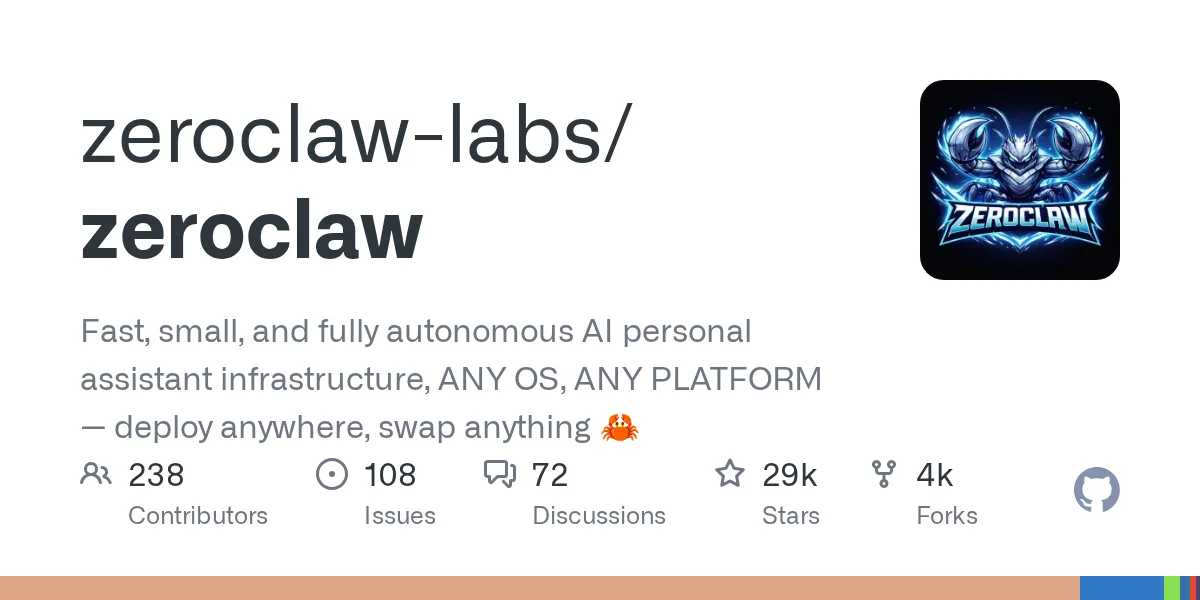
ZeroClaw's GitHub repository--28,000+ stars in 7 weeks. Source: GitHub - zeroclaw-labs/zeroclaw
1. Trait-Based Pluggable Architecture: Modular Without the Bloat
ZeroClaw's core design leverages Rust's trait system to create a fully pluggable architecture. Every subsystem--Provider, Channel, Memory, Tool, Runtime--is defined as a simple trait interface. You can swap or extend any component without touching core logic.
This is fundamentally different from OpenClaw's YAML-based workflow chaining. Here's what each trait abstracts:
- Provider: 28+ LLM backends (OpenAI, Anthropic Claude, Google Gemini, OpenRouter, Groq, Ollama, and more). Hot-swap providers at runtime without restarts.
- Channel: 20+ messaging platforms (WhatsApp, Telegram, Slack, Discord, Signal, iMessage, Matrix, IRC, Email, Bluesky, MQTT). Feature gates compile only the channels you need.
- Memory: SQLite hybrid (default), Markdown, Lucid, Qdrant. Zero external dependencies for vector search.
- Tool: 70+ built-in tools (shell, Git, Jira, Notion, Google Workspace, MCP protocol).
- Runtime: Native execution or Docker sandboxing.
The trait approach means ZeroClaw stays lean by default and grows only in the directions you need. A deployment using two LLM providers and three messaging channels doesn't carry the overhead of the other 46 integrations.
2. Hybrid Memory System: Vector Search Without External Databases
One of ZeroClaw's most innovative technical components is its hybrid search engine built on SQLite. It stores vector embeddings as SQLite blobs and combines them with BM25 keyword search via the FTS5 extension (DeepWiki - ZeroClaw Memory System).
The default weighting is 70% vector similarity, 30% keyword matching:
- Vector search handles semantic similarity--"Rust memory safety" matches "zero-cost abstractions."
- Keyword search handles exact terms--code snippets like
tokio::spawnor specific API names.
An embedding cache prevents redundant computation, maximizing memory efficiency. The practical outcome: you get Pinecone-level semantic search running locally on a $10 board, with no external vector database required.
3. Performance Benchmarks: The 99% Memory Reduction Is Real
The headline claim--99% less memory than OpenClaw--has been validated across three cloud providers and two edge devices, though independent third-party benchmarks are still pending (AdvenBoost).
| Metric | OpenClaw | ZeroClaw | Improvement |
|---|---|---|---|
| RAM Usage | 1GB+ | < 5MB | 99% reduction |
| Cold Start | 5+ seconds | ~10ms | 100x faster |
| Binary Size | 800+ npm packages | 3.4-8MB single binary | Single file deployment |
| Dependencies | Node.js runtime + GC | Statically linked Rust | Zero runtime overhead |
The technical explanation is straightforward. OpenClaw loads 800+ npm packages into the Node.js runtime, which includes garbage collection overhead. ZeroClaw statically links all dependencies into a single binary and relies on Rust's compile-time memory safety for zero runtime overhead. Cross-compilation via musl produces static binaries for 40+ architectures.
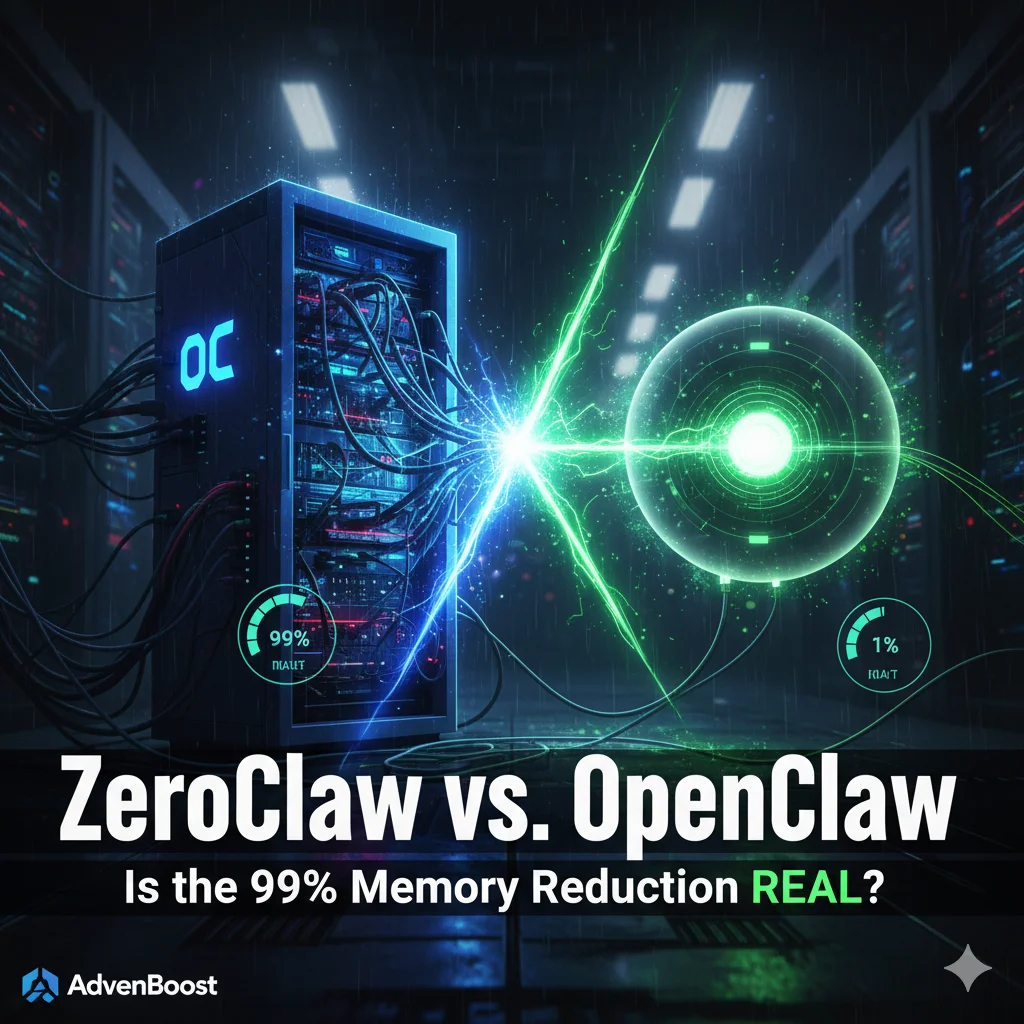
ZeroClaw vs OpenClaw benchmark comparison. Source: AdvenBoost - ZeroClaw vs. OpenClaw
4. Security-by-Default: Multi-Layer Protection for Autonomous Agents
As AI agents gain more autonomy, security becomes non-negotiable. ZeroClaw adopts a security-by-default approach with five protection layers:
- Gateway: Binds to localhost (127.0.0.1) only. Six-digit one-time pairing code authentication.
- Filesystem: Workspace scoping blocks access to system directories (/etc, /root, ~/.ssh). Symlink escape detection prevents sandbox breakouts.
- Execution: Deny-by-default channel allowlist. Optional seccomp-bpf sandboxing for process-level isolation.
- Autonomy Levels: ReadOnly, Supervised (default), or Full--giving operators granular control over agent capabilities.
- Secret Management: AES-256-GCM encrypted storage for API keys. HashiCorp Vault integration available.
One concern worth noting: impersonation domains (zeroclaw.org, zeroclaw.net) and unofficial repositories have appeared. The project maintainers issued a security advisory on GitHub Issue #527. Always verify you're installing from the official repository at github.com/zeroclaw-labs/zeroclaw.
5. Real-World Edge Deployments: From Factory Floors to Drone Swarms
ZeroClaw isn't theoretical. Production-grade edge deployments are already being reported across multiple industries:
Industrial IoT Predictive Maintenance. Vibration sensor data flows into a ZeroClaw agent running on a $10 microcontroller, which predicts bearing failures 48 hours in advance--with zero cloud round-trip latency (BrightCoding).

ZeroClaw running on edge hardware for IoT applications. Source: BrightCoding - ZeroClaw: The $10 AI Assistant
Offline Medical Diagnostics. A $15 Orange Pi running ZeroClaw provides basic diagnostic assistance in rural areas with no internet connectivity. Fully offline operation is the differentiator.
Smart Home Local Control. ZeroClaw agents manage smart home devices over MQTT within the local network--no cloud dependency, complete privacy.
Agricultural Drone Swarms. Multiple sub-$100 drones each running ZeroClaw coordinate via direct ESP32/STM32 firmware integration for real-time sensor processing and swarm decision-making.
Network Intrusion Detection. Repurposed routers running ZeroClaw detect network traffic anomalies as a lightweight IDS--no dedicated server required.
Cost Impact. Running on a $4/month Hetzner VPS, users report six simultaneous agents. AWS EC2 costs drop from $30.40 (OpenClaw) to $12.80 (ZeroClaw)--a 58% reduction. DigitalOcean shows 75% savings ($24 to $6) (AdvenBoost).
6. Competitive Landscape: The Claw Ecosystem Fragmentation
ZeroClaw doesn't exist in isolation. The broader "Claw" ecosystem has fragmented rapidly around OpenClaw:
| Runtime | Language | Positioning | GitHub Stars |
|---|---|---|---|
| OpenClaw | Node.js/Swift | Enterprise standard | 200,000+ |
| ZeroClaw | Rust | Ultra-lightweight edge | 28,000+ |
| NanoClaw | Python | Python lightweight | - |
| PicoClaw | - | Minimalist | - |
| IronClaw | - | Security-focused | - |
| NullClaw | Zig | Extreme minimal | - |
Each alternative adopts a different language and design philosophy, which limits interoperability (Medium - Claw Ecosystem Analysis). This fragmentation creates vendor lock-in risk for early adopters.
ZeroClaw's positioning is smart: rather than competing head-on with OpenClaw in the enterprise cloud segment, it targets the edge/IoT niche that OpenClaw structurally cannot serve. The question is whether OpenClaw will eventually ship a lightweight mode that erodes this advantage.
7. Strategic Outlook: AI Agent Democratization Is Irreversible
ZeroClaw represents something larger than a single tool. When you can run an autonomous AI agent on $10 hardware, you fundamentally change who has access to AI infrastructure.
Short-term (3-6 months): Expect ZeroClaw v1.x stabilization, plugin marketplace launch, improved documentation, and enhanced OpenClaw migration tooling. The zeroclaw migrate openclaw command already auto-converts memory, files, and settings.
Medium-term (1-2 years): WASM runtime support will enable browser-based AI agents. GPU/NPU hardware acceleration will dramatically improve edge inference performance. The addition of enterprise features (multi-tenancy, RBAC, audit logging) will determine whether ZeroClaw can expand beyond its edge niche.
Long-term (3+ years): Standardization competition will intensify. Rust and Zig-based runtimes will likely dominate edge/IoT, while OpenClaw consolidates in cloud/enterprise. Cross-system persona standards like AIEOS v1.1 will be critical for ecosystem integration.
Signals to monitor:
- ZeroClaw GitHub star trajectory and contributor growth
- Major cloud vendor (AWS, GCP, Azure) edge AI runtime announcements
- OpenClaw's lightweight mode response strategy
- First commercial enterprise deployment case study
Risks and Limitations: What to Evaluate Before Adopting
Production maturity. ZeroClaw is two months old. OpenClaw has 3+ years of battle-testing. Expect rough edges in error messages and documentation. Start with non-critical workloads.
No independent benchmarks. The 99% memory reduction claim is validated internally but lacks independent third-party verification. Run your own benchmarks before committing.
No native multimodal support. Image and PDF processing requires external tools (ImageMagick, Poppler). OpenClaw's built-in vision models have no ZeroClaw equivalent yet.
Ecosystem immaturity. No plugin marketplace. Community size is ~14% of OpenClaw's. The 70+ built-in tools may be sufficient, but custom extensions require Rust development.
Rust learning curve. JavaScript/Python teams should budget 2-4 weeks for Rust onboarding. Custom plugin development requires systems-level expertise.
Project sustainability. Fully free and open-source with no revenue model. Community-maintained with no corporate backing. Core developer departure could stall momentum.
Frequently Asked Questions
What is ZeroClaw?
ZeroClaw is a Rust-based open-source AI agent runtime that runs autonomous AI agents on hardware as inexpensive as $10 with under 5MB of RAM. It supports 28+ LLM providers, 20+ messaging channels, and 70+ tools in a single 3.4MB binary.
How does ZeroClaw compare to OpenClaw?
ZeroClaw uses 99% less memory (5MB vs 1GB+), starts 100x faster (10ms vs 5+ seconds), and deploys as a single binary instead of requiring 800+ npm packages. OpenClaw excels in enterprise features, ecosystem maturity, and plugin availability. ZeroClaw targets edge/IoT environments that OpenClaw cannot serve.
Can ZeroClaw run on a Raspberry Pi?
Yes. ZeroClaw runs on Raspberry Pi Zero, Orange Pi, ESP32, and any hardware with 5MB+ of available RAM. It cross-compiles to 40+ target architectures via musl-based static binaries.
Is ZeroClaw production-ready?
ZeroClaw has been available for approximately two months as of April 2026. Real-world edge deployments have been reported in IoT, healthcare, and smart home applications, but the project lacks the multi-year battle-testing of OpenClaw. Start with non-critical workloads and run your own benchmarks.
How much does ZeroClaw cost?
ZeroClaw is completely free under the MIT/Apache-2.0 dual license with no SaaS fees. Infrastructure costs can be as low as $4/month for a VPS running six simultaneous agents.
Conclusion: A Calculated Bet on the Edge
ZeroClaw is the only production-grade runtime that can run autonomous AI agents on $10 hardware with 5MB of RAM. For edge/IoT deployments, cost-sensitive environments, and privacy-first architectures, it's worth immediate evaluation.
For large-scale enterprise environments, the ecosystem immaturity and missing multi-tenancy features mean waiting is the pragmatic choice.
The broader trend is irreversible: AI agents are moving from cloud to edge. Whether through ZeroClaw or a similar lightweight runtime, your AI infrastructure strategy needs to account for this shift.
Recommended next steps:
1. Pilot ZeroClaw on non-critical internal automation workloads
2. Run your own benchmarks against OpenClaw in your target environment
3. Quantify TCO savings over a 3-month evaluation period
Sources
- ZeroClaw GitHub Repository - Official source code and documentation
- OpenClaw vs ZeroClaw: Definitive AI Agent Framework Comparison 2026 - SparkCo AI comparative analysis
- ZeroClaw: The $10 AI Assistant That Runs on 5MB RAM - BrightCoding use cases
- ZeroClaw vs. OpenClaw: Is the 99% Memory Reduction Actually Real? - AdvenBoost benchmark analysis
- Open Source Project of the Day: ZeroClaw - DEV Community technical review
- ZeroClaw Memory System - DeepWiki memory architecture analysis
- ZeroClaw Review: Rust-based OpenClaw Alternative - SparkCo AI review
- Claw Ecosystem Analysis - Medium ecosystem overview
- ZeroClaw Official Site - ZeroClaw Labs official website
- ZeroClaw Security Statement - Official security advisory
Published by AboutCoreLab AI Research Team | April 2, 2026