Hermes Agent Review 2026: 7 Reasons This Self-Improving AI Is Redefining Open-Source Agents
Published April 14, 2026 · AboutCoreLab AI Research Team
Hermes Agent is the first open-source AI agent that actually gets smarter the longer you run it. Released by Nous Research on February 26, 2026, it hit 78,800 GitHub stars and 419 contributors in under two months — and beat fresh-instance baselines by 40% on repeat research tasks (Nous Research, Frank's World).
If you've been watching OpenClaw dominate integration breadth with 345,000+ stars, Hermes Agent is the other half of the story. It's not trying to plug into 50 platforms. It's trying to remember what it learned yesterday — and apply it tomorrow.
Here's what every engineering leader, founder, and AI researcher needs to know before 2026 Q3.

OpenClaw vs. Hermes Agent architectural comparison. Source: The New Stack
What Is Hermes Agent?
Hermes Agent is an MIT-licensed autonomous AI agent from Nous Research that lives on your server, stores a persistent memory of past interactions, and autonomously writes skill documents after completing complex tasks. Unlike session-based frameworks, it treats every interaction as training data for itself.
The official tagline says it plainly: "An autonomous agent that lives on your server, remembers what it learns, and gets more capable the longer it runs" (Nous Research).
Three things make it different from every other agent framework shipped this year:
- A closed learning loop that fires after any task using 5+ tool calls
- A three-tier memory system (session, persistent, user model) backed by SQLite FTS5
- 200+ model compatibility including the in-house Hermes 4 family (405B, 70B, 36B, 35B MoE)
Why Hermes Agent Exploded: The 6-Week Growth Story
The numbers are hard to ignore. In its first six weeks, Hermes Agent recorded:
- 57,200 GitHub stars (roughly 9,500/week — 3x OpenClaw's early pace)
- 7,572 forks and 274+ contributors
- 80+ ecosystem projects launched on top of it
- By April 13, v0.9.0 pushed totals to 78.8k stars, 419 contributors, 4,075 commits (Hermes Atlas, GitHub)
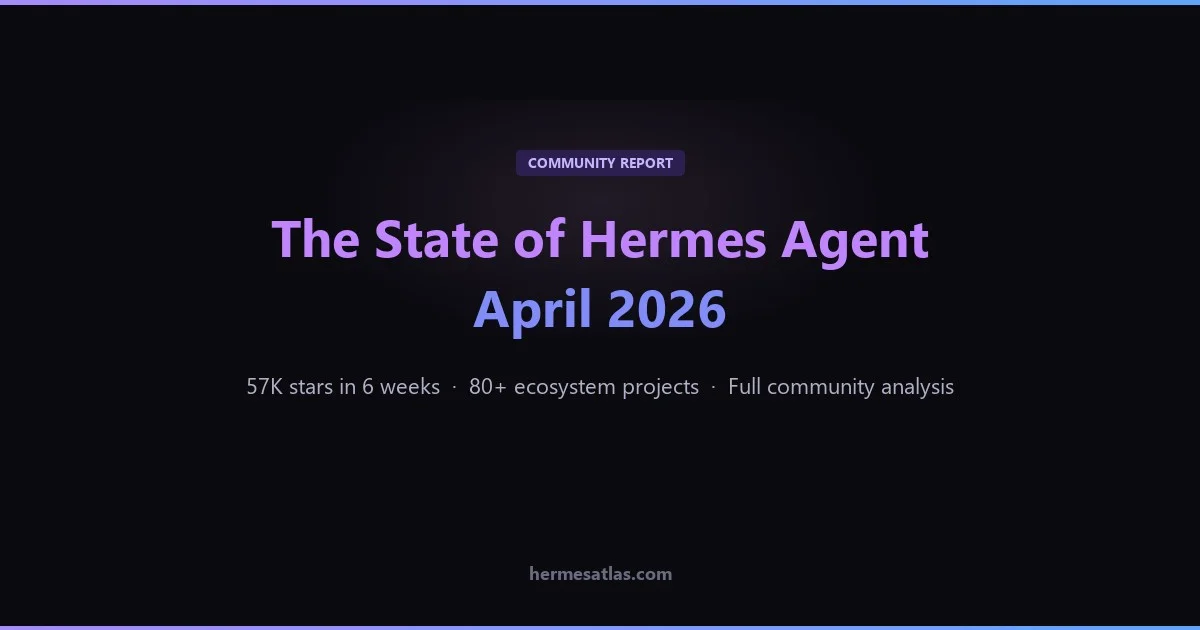
The State of Hermes Agent — April 2026. Source: Hermes Atlas
April also brought a MiniMax partnership, with MiniMax M2.7 going live inside Nous Portal. That's not a cosmetic integration — both teams are co-optimizing future releases specifically for agent workloads (MiniMax Docs). We're watching model providers and agent providers vertically merge in real time.
How the Closed Learning Loop Actually Works
This is the feature that earned the "self-improving" label. The loop runs in five stages:
- Receive a message from any connected platform (Telegram, Discord, Slack, WhatsApp, Signal, Email)
- Recall relevant skills and memories via FTS5 full-text search (roughly 10ms across 10,000+ documents)
- Reason and execute tool calls
- Reflect — after any complex task (5+ tool calls), the agent autonomously writes a skill document describing what worked
- Persist results into memory and update the user model (NxCode)
The real-world payoff: in a hands-on benchmark, a v0.5.0 install generated three skill documents within two hours and reproduced the advertised 40% speedup on similar research tasks — without any prompt tuning (The New Stack).
The Three-Tier Memory System
Hermes doesn't just dump everything into a vector store. It uses what the team calls bounded memory with forced curation:
- Session memory — current conversation context
- Persistent memory — FTS5-indexed long-term storage
- User model — auto-profiled preferences and expertise
Core notes are capped at 2,200 characters. User profiles at 1,375. The hard limits force the agent to compress and distill, which is the opposite of what most RAG systems do (Hermes Atlas).
The Economics: Why $5/Month Matters
Here's where Hermes separates itself from enterprise-only agent platforms:
| Component | Cost |
|---|---|
| Framework license | Free (MIT) |
| VPS hosting | $5–30/month |
| API usage | $15–80/month (Nous Portal, OpenRouter, etc.) |
| Fully local (Ollama) | $0 |
Source: OpenAIToolsHub
Hermes AI Agent hands-on review. Source: OpenAIToolsHub
A 2-week PoC costs under $30. That's the real story — not the stars, not the benchmarks. Nobody has to justify a $30 experiment to a CFO.
Hermes vs. OpenClaw vs. Claude Code: Who Wins Where?
Industry reviewers are converging on a "portfolio, not choice" framing, and it's the right one (Hermes Atlas, The New Stack):
- Claude Code — best for IDE pair-programming
- OpenClaw — best for team operations and broad channel coverage (50+ platforms, 5,700+ community skills)
- Hermes Agent — best for personal learning automation, research workflows, and model flexibility (200+ models)
Put differently: OpenClaw wins on breadth. Hermes wins on depth. Pretending you have to pick one is a strategic mistake.
The Model Layer: Hermes 4 Is Doing Real Work
A lot of agent frameworks are model-agnostic wrappers. Hermes actually benefits from a matched model family. Hermes 4 (Meta-Llama-3.1-405B base) introduces a hybrid reasoning mode using <think>...</think> tags for internal deliberation, and function calls use <tool_call> tokens registered as added tokens — which makes streaming parsing genuinely clean (Hugging Face).
VLLM parses it with tool parser=hermes. SGLang uses qwen25. If you've fought with tool-call parsing in production, you know why this matters.
Hermes 4 35B A3B is the interesting one — 35B total parameters with 3B active per token (MoE), fine-tuned on actual agentic traces. That's not a generic chat model adapted for agents. It was built for them.
Where Hermes Still Breaks: The Honest Limitations
I'd be doing you a disservice if I glossed over this part.
Token overhead is real. Reflection modules add 15–25% token overhead, and 73% of API calls go to fixed tool-definition costs averaging $0.30/call (NxCode). Route high-frequency simple tasks to lightweight local models. Reserve the learning loop for genuinely complex, repeatable work.
Self-learning is off by default. Multiple community reports flagged "it's not working as advertised" confusion. You have to explicitly enable it via hermes config. Not a bug, but a communication gap.
Memory transparency is weak. The user profile gets auto-generated, but inspecting what the agent actually remembers is hard. For GDPR and Korea's PIPA compliance, you'll need to design data retention, audit, and deletion processes manually. Built-in moderation and audit trails exist — use them (MiniMax Docs).
API stability isn't guaranteed. Going from v0.1.0 to v0.9.0 in two months means breaking changes are likely. Don't bind mission-critical workflows directly. Build an abstraction layer and wait for v1.0 LTS.
Platform coverage is narrow. Six channels vs. OpenClaw's 50+. If you need Webex or Zoom Team Chat, you're writing a custom gateway first.
A Realistic 12-Week Adoption Path
Skip the hype cycle. Here's what works:
- Week 1 — One developer. $5 VPS. Run
curl -fsSL https://hermes-agent.nousresearch.com/install.sh | bashthenhermes setup. - Weeks 2–4 — Pick one research or reporting automation. Enable self-learning. Measure whether the 40% speedup reproduces on your workload.
- Weeks 5–8 — Split by team using Hermes profiles. Connect internal tools via MCP.
- Weeks 9–12 — ROI review. Decide whether to wait for v1.0 LTS or move to production with abstraction guardrails.
Strategic Signals to Watch
Hermes Agent's arrival sends three macro signals to the industry:
- The center of gravity is shifting from model-scale innovation to agent and memory innovation
- The market is bifurcating into integration breadth (OpenClaw) and learning depth (Hermes) — portfolio strategies will beat single-vendor bets
- Vertical integration is accelerating — MiniMax × Nous is the first of many model-agent marriages, and "agent-optimized model SKUs" are coming to OpenRouter and Nous Portal
For executive monitoring, the four checkpoints that actually matter:
- v1.0 LTS release timing
- Third-party independent benchmarks reproducing the 40% speedup
- Additional official partnerships beyond MiniMax (Anthropic? Google? OpenAI?)
- First public enterprise reference customer
Frequently Asked Questions
What is Hermes Agent, exactly?
Hermes Agent is an open-source, MIT-licensed autonomous AI agent framework from Nous Research. It runs persistently on your server, maintains a three-tier memory system (session, persistent, user model), and autonomously generates reusable skill documents after completing complex tasks — making it measurably faster on repeat work over time.
How is Hermes Agent different from OpenClaw?
OpenClaw prioritizes integration breadth with 50+ platform connectors and 5,700+ community skills. Hermes Agent prioritizes learning depth with a closed self-improvement loop and 200+ model compatibility. They're complementary, not competitive — most mature AI teams will end up using both.
Is the 40% speedup real?
It's reported by Nous Research's official benchmarks and independently reproduced in a hands-on test by The New Stack on v0.5.0, where three auto-generated skill documents delivered the speedup on similar research tasks without prompt tuning. However, enterprise-scale independent benchmarks are still pending — wait for them before betting mission-critical workflows on this number.
How much does Hermes Agent cost to run?
The framework is free under MIT license. A minimal deployment runs on a $5/month VPS with local Ollama inference at roughly $0 in API costs. With paid APIs via Nous Portal or OpenRouter, expect $15–80/month. A full 2-week proof-of-concept can be run for under $30.
Is Hermes Agent production-ready?
Not yet for mission-critical workloads. The framework went from v0.1.0 to v0.9.0 in two months, meaning breaking changes remain likely. Memory transparency for compliance audits is limited. Wait for the v1.0 LTS release and build an abstraction layer before committing production workflows.
Can Hermes Agent be used commercially?
Yes. The MIT license permits commercial use, modification, and redistribution without royalty. Nous Research monetizes through Nous Portal API consumption and enterprise partnerships rather than framework licensing.
The Bottom Line
Hermes Agent is the first serious open-source reference for "agents that get better over time." The 40% research-speed claim is credible but not yet enterprise-validated. The economics are absurdly low. The risks are concentrated in version volatility, memory opacity, and token overhead — all of which can be managed with disciplined engineering.
If you're not running a $30 PoC in the next 30 days, you're going to hear about this framework from your competitors first.
Recommended next step: Approve a 2-week proof-of-concept with one researcher, a $5 VPS, and local Ollama inference. Measure the 40% speedup on your actual workloads. Bring findings to the next quarterly strategy review alongside an OpenClaw comparison.
Sources & Further Reading
- Hermes Agent — An Agent That Grows With You (Nous Research)
- NousResearch/hermes-agent on GitHub
- The State of Hermes Agent — April 2026 (Hermes Atlas)
- Complete Guide to the Self-Improving AI 2026 (NxCode)
- OpenClaw vs. Hermes Agent (The New Stack)
- Unveiling the Hermes Agent (Frank's World)
- Hermes AI Agent Framework Review (OpenAIToolsHub)
- Hermes Agent — MiniMax API Docs
- NousResearch/Hermes-4-70B (Hugging Face)
Written by the AboutCoreLab AI Research Team. We analyze AI infrastructure, agent frameworks, and emerging developer tooling for executive decision-making.